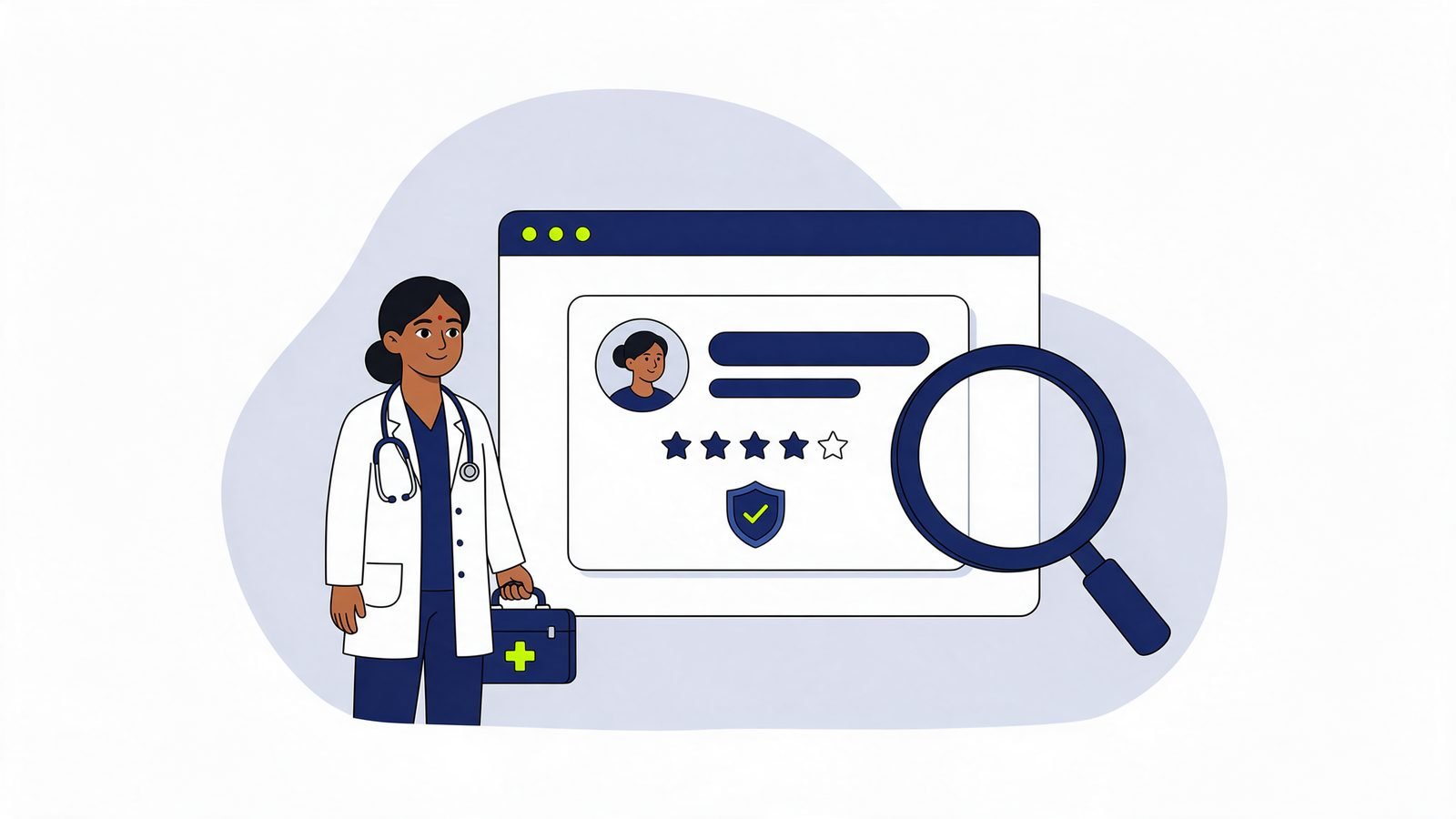
What does E-E-A-T mean, in Google's own words?
Google explains E-E-A-T in its guide to creating helpful, reliable, people-first content. Here's the short version, translated for a business owner:
- Experience: have you actually done the thing? A clinic that has treated hundreds of patients, a jeweller who has set the stones, a contractor who has built the kitchen.
- Expertise: do you have the knowledge or qualifications to speak on it?
- Authoritativeness: do others recognise you as a go-to source? Mentions, links, awards, associations.
- Trust: is the page honest, accurate, safe and clear about who is behind it?
Google says plainly that "trust is most important" and the other three feed into it. It also says E-E-A-T is not itself a ranking factor. Instead, Google's systems look for a mix of signals that line up with it, and its human quality raters use E-E-A-T to judge whether those systems are working. Raters do not change rankings directly.
Why it matters more after the 2025 and 2026 core updates
Google confirms its larger ranking changes on its Search Status Dashboard. Since the start of 2025 it has confirmed five core updates and five spam updates.
Core updates: March, June and December 2025; March and May 2026. Spam updates: August 2025; March, June, August and September 2026.
Source: Google Search Status Dashboard, ranking incident history.
Google does not publish a list of what each core update changed. What it does publish is the same guidance every time: if your rankings dropped, look at whether your content is genuinely helpful and trustworthy compared with what else is out there. The rising number of spam updates is a clear signal that thin, mass-produced and manipulative pages are being filtered harder.
For small businesses this is mostly good news. A real business with real experience is exactly what these updates are trying to surface. You just have to make that experience visible.
Your customers run their own E-E-A-T check
Forget Google for a moment. People decide whether to trust you in seconds, and the same gaps that worry Google lose you customers.
BrightLocal asked 1,227 consumers in 2026 why they decided not to contact a local business they had found online.
Source: BrightLocal, What makes consumers choose your business? (July 2026, 1,227 US consumers).
Almost every reason on that list is a trust signal: proof from other customers, honest prices, accurate details, and signs that someone is actually running the business. Fixing these helps your conversions this week, whatever Google does next.
Which pages need the most care?
Google applies a higher bar to what it calls "Your Money or Your Life" topics: anything that could affect someone's health, financial stability, safety or wellbeing. If you run a clinic, pharmacy, financial service, legal practice, school or anything involving safety, assume your pages are judged more strictly.
For these businesses, the essentials are not optional:
- The name and qualifications of the professional behind the advice.
- Registration or licence details where your profession requires them.
- A clear statement that general information is not a substitute for a consultation.
- A date showing when medical, legal or financial information was last reviewed.
Every other business still benefits from the same habits, with a lighter touch.
The page-by-page E-E-A-T checklist
Home page
- Say who you are, what you do and where, in the first screen.
- Show your full address, phone number and opening hours, matching your Google profile exactly.
- Add one or two real proof points: years in business, number of customers served, a recognisable certification or brand partnership.
About page
- Name the owner and key team members, with real photos and their background.
- Tell the honest story: when you started, what you specialise in, what you will not do.
- Link to proof elsewhere: press mentions, association memberships, awards.
Service and product pages
- Describe the service in plain words, including who it is for and who it is not for.
- Give price ranges or starting prices where possible.
- Show your own photos of the work, not stock images.
- Add a short FAQ from real customer questions.
Articles and guides
- Put a real author name on every article, linking to their bio.
- Cite sources for statistics and claims, with links.
- Add something only you can add: an example from your work, a mistake you see often, a photo you took.
- Only change the "updated" date when you genuinely update the content. Google lists changing dates to look fresh as a warning sign.
Who, How and Why: Google's three questions for every page
Google suggests asking three questions about any content you publish.
Who created it? Make authorship obvious with a byline and a short bio. Google is blunt about the shortcut some sites take: fabricating author profiles is "a form of deception".
How was it created? If you used tools, including AI, to help write or research, say so where a reader would reasonably want to know. Google does not penalise AI use in itself. It penalises content made mainly to manipulate rankings, and it describes large amounts of AI text published without human oversight as "little to no effort".
Why was it created? The answer should be "to help someone who came to us". If the honest answer is "to get traffic for a keyword", the page is unlikely to hold its ground.
This guide, for example, was researched and written by our team with AI assistance for research and drafting, and every figure was checked against the source linked at the bottom.

Things that look like E-E-A-T but are not
Some popular tactics borrow the language without the substance. They waste time at best.
- Adding "expert" badges or fake review widgets. If a reader cannot verify it, it does not build trust.
- Stuffing author bios with keywords. A bio is for readers; one honest paragraph beats a list of buzzwords.
- Buying links from unrelated sites. Google's spam policies cover link schemes explicitly.
- Writing about everything. Google's warning signs include sites that publish on many unrelated topics hoping some will rank. Stay close to what you actually do.
- Only adding schema markup. Structured data helps machines read facts you already show. It cannot create trust that the visible page lacks.
Questions people ask about E-E-A-T
Is E-E-A-T a Google ranking factor?
Not directly. Google says E-E-A-T itself is not a ranking factor. Its systems use many signals that line up with experience, expertise, authority and trust, and its quality raters use E-E-A-T to evaluate whether those systems are working.
Does a small business need author bios?
For articles and advice pages, yes. A named author with a short, honest bio helps readers and Google understand who is behind the advice. For service pages, the business itself, with a clear address and team page, is usually enough.
Can AI-written content have good E-E-A-T?
It can, if a knowledgeable person adds real experience, checks every fact and takes responsibility for it. Google judges the content and its purpose, not the tool, but mass-produced AI text without oversight is treated as low effort.
How long does it take to see results?
Trust changes are usually picked up gradually as Google recrawls your pages, and core updates often reassess sites. Plan in months. The customer-facing benefits, like fewer people leaving your contact page, can show up much sooner.
How can I check my pages?
Read each key page as a stranger would and ask whether you can tell who is behind it, what they have done and why you should believe them. Our free SEARCH ONE audit also flags missing trust signals such as author information, contact details and structured data.
About the author
Praveen Kumar, Founder, Vectura Digital
Praveen Kumar is the founder of Vectura Digital, which builds SEARCH ONE, a website audit for SEO, AEO and GEO, and GMB ONE, a Google Business Profile audit. He works with local businesses in India on how search engines and AI assistants read and recommend them.