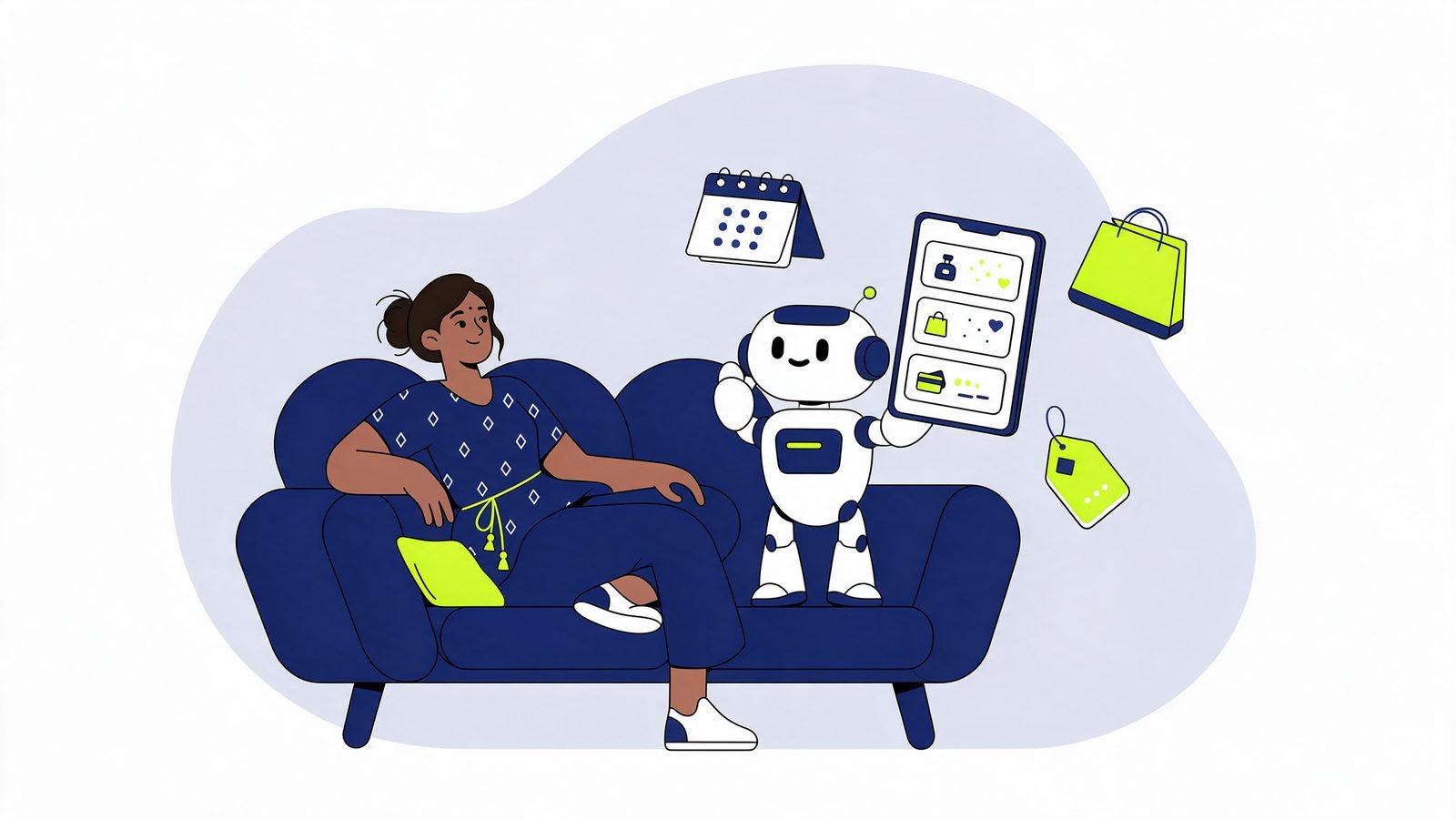
First, what is an "AI agent" in plain words?
A search engine shows you options. An agent goes and does something with them.
Ask a normal search engine for "pet grooming near me" and you get ten results to sort through yourself. Ask an agent the same thing and it can check which groomers have a slot on Saturday, what they charge for a medium-sized dog, and hand you a short list with booking links. Some agents will even phone the businesses for you.
That is not science fiction any more. Since 2025 the big platforms have been shipping exactly these features, one category at a time. Most are still US-first and many are still experiments. But the direction is clear, and the businesses that make themselves easy for agents to understand will have a head start when these tools reach India.
What actually launched in 2025 and 2026
It helps to separate what is real from what is talked about. Here's the timeline of things the companies themselves announced:
- July 2025: Google Search began calling local businesses in the US to check pricing and availability for users, starting with services like pet grooming and dry cleaning. Google said "businesses are always in control via their Business Profile settings".
- August 2025: Google's AI Mode started finding restaurant reservations across platforms like OpenTable and Resy, for US subscribers in a Labs experiment.
- September 2025: OpenAI launched Instant Checkout in ChatGPT for US shoppers, starting with Etsy sellers.
- October 2025: In India, NPCI, Razorpay and OpenAI announced a private pilot of UPI payments inside ChatGPT, with BigBasket among the first merchants.
- January 2026: Google announced the Universal Commerce Protocol, an open standard for agent shopping built with Shopify, Etsy, Wayfair, Target and Walmart, and endorsed by Flipkart, Visa and Mastercard among others.
- May 2026: At Google I/O, Google announced search agents that can book local experiences and services, and call businesses in categories like home repair, beauty and pet care, rolling out to US users that summer.
Notice the pattern. Each step gives the agent a bit more permission: first to look, then to ask, then to book, and finally to pay.
The part the hype left out: people still like to finish the purchase themselves
In-chat buying has had a bumpy start. By early 2026, reports said only a few dozen Shopify merchants were live on ChatGPT's Instant Checkout, and in March 2026 OpenAI told Modern Retail that Instant Checkout was "moving to Apps". Walmart's executives reportedly found that purchases completed inside ChatGPT converted at about a third of the rate of shoppers who clicked through to Walmart's own site.
Survey data points the same way. A Semrush-commissioned survey of US shoppers who use AI found far more people buying after AI research than buying inside the AI tool itself.
1,030 US shoppers with AI experience, December 2025. Reported figures; treat as indicative.
Source: Semrush-commissioned survey, as reported by Digital Applied (2026).
So the realistic picture for 2027 is "discover in AI, buy with the business". The agent does the comparing and shortlisting. The customer, or the agent with their permission, then goes to your website, your booking page, your phone line or your shop. That is good news for small businesses: you don't need to integrate with every AI platform. You need to be the obvious, trustworthy option on the shortlist.
How an agent decides who makes the shortlist
No company publishes its full recipe, but the public documentation gives strong clues. Google said its AI calling feature picks businesses using its normal local search rankings. Its booking features pull from partner platforms, the Knowledge Graph and Google Maps. Shopping agents read product feeds and the pages behind them.
Put simply, an agent needs answers to five questions, and it is far more likely to pick you if it can answer them without guessing:
- What exactly do you offer? Specific services and products, in plain words.
- How much does it cost? A price, a price range or a clear "from" price.
- Can you do it when they want? Opening hours, special hours, availability or a booking calendar.
- Can they trust you? Reviews, a real address, years in business, clear policies on refunds and cancellations.
- How do they act? A booking link, a phone number that gets answered, a working checkout or a WhatsApp number.
Each of these is a field that many small business websites and profiles still leave blank. An agent can't fill a blank with charm. It simply moves on to the next business.
Get ready: an agent-friendly checklist for 2027
On your website
- Give every service or product line its own page, with the price or price range in text, not just in an image.
- Add your cancellation, refund, delivery and warranty policies on their own clearly linked page.
- Add a real booking or enquiry path: an online booking link, a form, or at least a click-to-call and WhatsApp button that works on mobile.
- Use structured data that matches what visitors see: LocalBusiness, Product or Service with Offer prices, and FAQ where you genuinely answer questions.
On your Google Business Profile
- Fill in services and products with prices where you can.
- Keep regular and special hours accurate. An agent is unlikely to book a business it believes is closed.
- Add your booking link if your category supports it.
- Check your Business Profile settings for AI calls and decide whether you want them. In the US, Google gives businesses that control.
In the shop
- Decide who answers the phone and how. If an AI calls to ask about price and availability, a clear, quick answer wins the customer.
- Write down your standard answers: today's prices, typical waiting time, what is included.
For the website basics behind all this, see our technical checklist for AI search.
What this means for Indian businesses specifically
Most of the agent features above launched in the US first. India usually follows, and in a few areas it is moving early. The UPI-in-ChatGPT pilot is one example: the payment rail Indian customers already trust most is being wired into AI assistants.
There are two practical lessons here.
First, UPI-ready and WhatsApp-ready businesses will have an edge. If an agent can hand a customer straight to a UPI payment or a WhatsApp chat with you, the path from "AI recommended this shop" to "paid" gets very short.
Second, your Google data is your passport. Google is the platform most Indian customers start from, and its agents lean on Google Maps and Business Profile data. A complete, accurate profile is the cheapest way to get ready. Our Google Business Profile checklist walks through every field.
What not to do
- Don't buy "AI agent optimisation" packages that promise placement. No agent platform sells guaranteed organic recommendations.
- Don't publish prices you won't honour. Agents quote what your page says. A wrong price shown to a customer is worse than no price.
- Don't hide your phone number to cut calls. Calls, human or AI, are how agents confirm details.
- Don't wait for perfect. You don't need integrations with every AI platform. Clear facts, current prices and a working booking path beat a half-built "AI strategy".
Questions about AI agents and small businesses
Can AI agents book appointments with my business?
In the US, Google's agents can already find and link to bookings for restaurants and, from summer 2026, for more local services. They usually send the customer to your booking page or partner platform to finish. In India these features are not widely available yet, so the best preparation is a clear booking path and an accurate Google Business Profile.
Will Google's AI phone my business?
Google's AI calling has been available in the US since July 2025 for categories like pet grooming, and expanded to more categories in 2026. Google says businesses are in control through their Business Profile settings. It has not launched widely in India yet.
Do I need to sell on ChatGPT to be found by AI?
No. Early in-chat checkout has had low adoption, and most AI shopping still ends on the business's own website or booking page. Being clearly described, priced and reviewed online matters far more than selling inside any one AI app.
What is the Universal Commerce Protocol?
It is an open standard Google announced in January 2026 so AI agents and online stores can work together on product discovery, checkout and support. It mainly affects online retailers. Local service businesses benefit more from complete Business Profiles and clear websites.
How do I know if my website is ready for AI agents?
Check that each service has its own page with a price or price range, that your hours and policies are easy to find, and that a customer can book or contact you in one tap on a phone. Our free SEARCH ONE audit checks one page for crawlability, answer-readiness and structured data.
About the author
Praveen Kumar, Founder, Vectura Digital
Praveen Kumar is the founder of Vectura Digital, which builds SEARCH ONE, a website audit for SEO, AEO and GEO, and GMB ONE, a Google Business Profile audit. He works with local businesses in India on how search engines and AI assistants read and recommend them.
Sources
- Google, Search can now call businesses to get pricing and availability (16 July 2025)
- Google, AI Mode in Google Search adds personalization and agentic features (21 August 2025)
- Google, How to ask Google to call local businesses for you (25 November 2025)
- Google, New tech and tools for retailers to succeed in an agentic shopping era (11 January 2026)
- Google, Search I/O 2026 updates: AI agents and more (19 May 2026)
- Fintech News Singapore, Razorpay pilots Agentic Payments beta with NPCI and OpenAI (13 October 2025)
- Digital Applied, Why AI checkout stalled: discover in AI, buy on site (2026)
- Search Engine Journal, Google Search can now call local businesses using AI (16 July 2025)