Are people really asking AI to recommend businesses?
Yes, and the jump in one year is the biggest change in local search we have seen in a long time.
BrightLocal's Local Consumer Review Survey asks the same group of questions every year. In 2025, 6% of consumers said they used ChatGPT or another AI tool to find local business recommendations. In the 2026 survey, that figure was 45%, which made AI tools the third most popular source of local recommendations in that survey.
Source: BrightLocal, Local Consumer Review Survey 2026 (1,002 US consumers).
Trust is following, but more slowly. In the same survey, 40% said they trust AI platforms for business recommendations, 42% said they trust AI recommendations as much as traditional reviews, and 82% said they read AI-generated summaries of reviews.
The survey is from the US, but the tools are the same everywhere. ChatGPT reported more than 900 million weekly users in February 2026, and Google reported 950 million monthly users for the Gemini app in July 2026.
Does AI actually send customers, or just answers?
Both, but keep your expectations honest.
SE Ranking measured ChatGPT referrals at 0.32% of all website traffic in May 2026 across more than 100,000 sites. That was a record high, and it is still a small slice. Similarweb counted AI platform visits to websites growing 117% year on year to mid-2026, and Adobe found AI-referred visits to US retail sites converted 54% better than other traffic in May 2026.
So the traffic is small, fast-growing and unusually ready to buy. The bigger effect for a local business is often invisible in analytics: someone asks ChatGPT for "a good orthodontist in Indiranagar", sees your name, then searches your name on Google or walks in. That is why you should also watch branded searches and direct enquiries, not only AI referral clicks.
Where do ChatGPT and other assistants get their information?
They do not have a secret list of businesses. They search the web, read pages and combine what they find. BrightLocal ran 800 local business searches in ChatGPT Search and recorded the sources it showed.
First ten sources for 800 searches across 20 business types and 20 US cities, November 2024.
Source: BrightLocal, Uncovering ChatGPT Search Sources.
Three things stand out:
- Your own website was the biggest single source, and for buying-intent searches ("dentist near me", "book a plumber") business websites made up 72% of sources.
- Mentions matter more than in Google. Articles, lists and local news that name your business made up 27% of sources, compared with 16% in BrightLocal's equivalent study of Google.
- Directories still count, but not always the ones you expect. Smaller "best of" directories appeared more often than the big platforms in that snapshot.
Each assistant also has its own search engine underneath. BrightLocal notes that ChatGPT Search relies on Bing's index, Gemini and Google's AI features use Google's index, and Perplexity runs its own crawler. That is why being findable in Bing as well as Google is now worth an hour of your time.
Step 1: Let the AI search crawlers into your website
Many websites block AI bots by accident, through an old security plugin, a hosting firewall or a copied robots.txt file. If the crawler cannot read your site, the assistant cannot cite it.
The crawlers that matter for appearing in answers are not the same as the ones that collect training data. OpenAI is clear about this: OAI-SearchBot is the one that surfaces websites in ChatGPT search, and "sites that are opted out of OAI-SearchBot will not be shown in ChatGPT search answers". GPTBot is the separate crawler for training data.
So a sensible setup for most businesses is:
- Allow OAI-SearchBot, ChatGPT-User, PerplexityBot, Claude-SearchBot and Bingbot.
- Keep Googlebot allowed (that covers Google's AI Overviews and AI Mode).
- Decide separately, as a business choice, whether to allow training crawlers like GPTBot and Google-Extended. Blocking those does not remove you from search answers.
Not sure what your site allows? Our free SEARCH ONE audit checks robots.txt rules for the main AI crawlers on the page you enter. The technical checklist for AI search explains each setting.
Step 2: Publish the facts an assistant needs to recommend you
When someone asks for "the best bridal jewellery shop in Jaipur under 2 lakh", the assistant needs pages that say, in text, what you sell, where, for whom and roughly for how much. Vague marketing copy gives it nothing to quote.
Check that your website has:
- One page per main service or product line, each with a plain description in the first paragraph.
- Price ranges or starting prices where you can share them. BrightLocal's 2026 decision research found 29% of consumers named clear pricing as a top reason for choosing a business, and 32% walked away from businesses with unclear pricing.
- Your area in words: the neighbourhoods, city and nearby places you serve.
- Proof: years in business, qualifications, brands you stock, number of projects or patients, awards, real photos.
- Answers to common questions, written the way customers ask them on the phone.
Write these for people first. A page that helps a human decide is exactly the page an assistant can summarise.
Step 3: Make your details identical everywhere
Assistants cross-check. If your website says you open at 10, Google says 11 and a directory lists an old phone number, the safest move for an AI is to recommend someone else.
Go through these places and make the name, address, phone number, website, hours and main services match exactly:
- Your website (footer and contact page)
- Your Google Business Profile
- Bing Places for Business (you can import from Google in a few clicks)
- Apple Business Connect, if you have iPhone customers
- The two or three directories that matter in your industry, such as Justdial, IndiaMART, Practo or Zomato
- Your social profiles
This is unglamorous work, and it is one of the few things fully in your control.
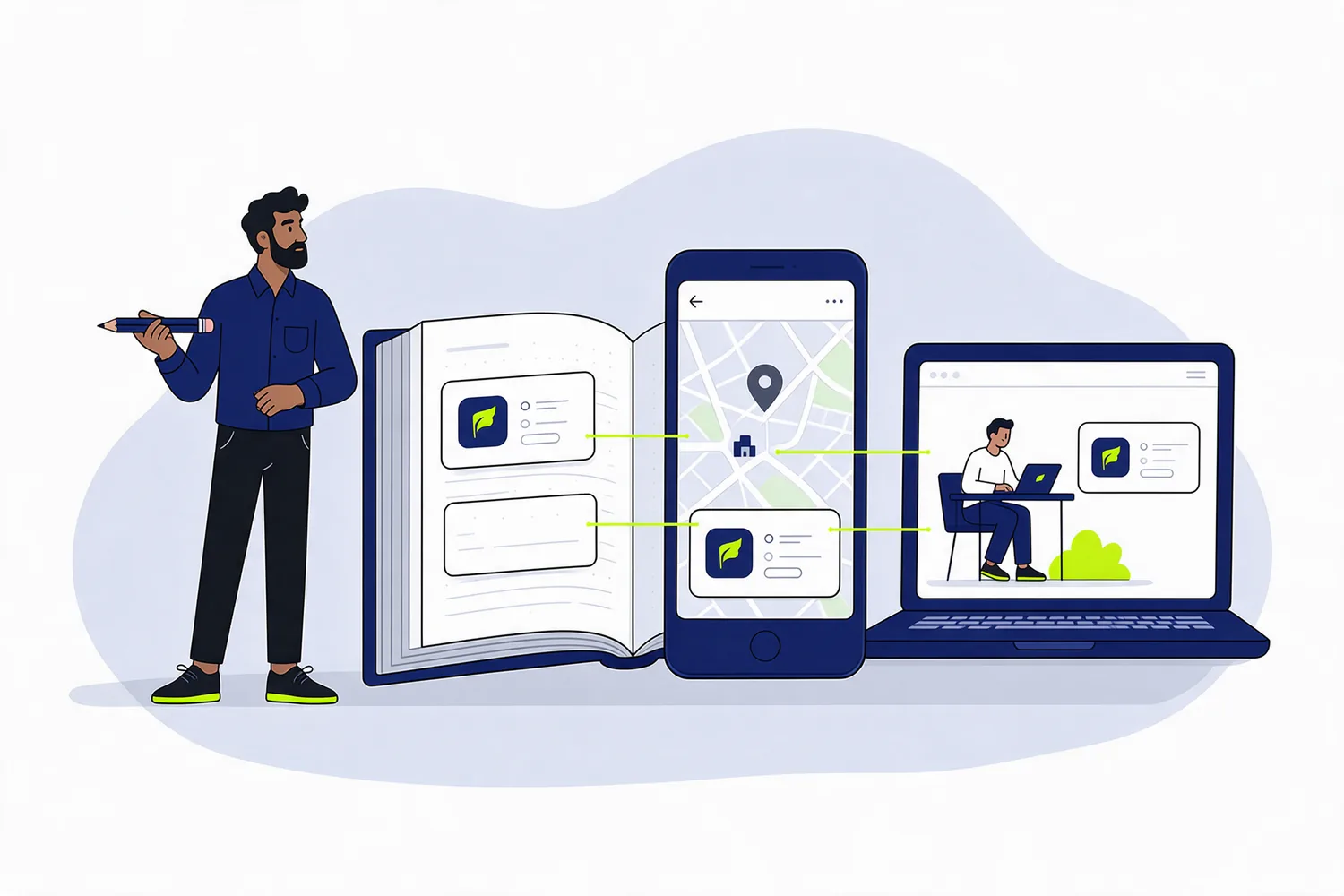
Step 4: Earn mentions and reviews you could show your mother
The 27% of sources that were "mentions" are articles, lists, interviews and community posts that name a business. You cannot fake these at scale without risk, and you do not need to. Start local:
- A quote or story in a local newspaper or city blog.
- Being listed by a supplier, brand or association you genuinely work with.
- Speaking at, sponsoring or hosting something in your community.
- Helpful answers in industry forums, signed with your real name and business.
Reviews matter too. With 82% of people reading AI-written summaries of reviews, your reviews effectively become what the assistant says about you. Ask every happy customer, reply to every review, and never buy or filter them. Our Google reviews guide covers what Google allows.
Step 5: Check what the assistants say about you
Once a month, ask ChatGPT, Gemini and Perplexity the questions your customers would ask. Use the words they use, including the area: "best skin clinic in Koramangala for acne", "affordable school uniform shop near Pali".
Write down three things each time: whether you are named, which sources are cited, and whether anything about you is wrong. If a fact is wrong, fix it at the source the assistant cited, not in the chat.
We explain a more structured way to track this in how to measure whether AI answers mention your business, and the bigger picture of how assistants choose brands in GEO in 2027.
What doesn't work (and can hurt you)
A lot of "AI SEO" advice in 2026 is recycled spam. Avoid these:
- Mass-produced AI pages for every suburb or keyword. Google's spam policies call content made mainly to manipulate rankings with automation a violation, and assistants built on search indexes inherit the same filters.
- Fake reviews or review swaps. Google removed or blocked more than 240 million policy-violating reviews in 2024 alone.
- Hidden text "for AI" or prompt-style instructions tucked into pages. Search engines treat hidden content as spam.
- Paying for "guaranteed ChatGPT placement". No one can sell that. The assistants do not take payment for organic recommendations.
The slow, honest version is also the one that keeps working when the tools change.
Common questions
Can I pay ChatGPT or Gemini to recommend my business?
No. Organic recommendations in ChatGPT, Gemini and Perplexity cannot be bought. Some of these companies are testing clearly labelled ads, but those are separate from the recommendations themselves.
Should I block GPTBot to protect my content?
That is a business decision. Blocking GPTBot stops OpenAI using your pages for training, but it does not remove you from ChatGPT search answers, which use OAI-SearchBot. Most local businesses benefit from allowing the search crawlers.
Does my Google Business Profile affect ChatGPT recommendations?
Indirectly, yes. Assistants check facts across several sources, and Google profiles, reviews and directory listings are among the most consistent ones. Keeping your profile complete and matching your website helps every assistant trust the details.
How long does it take to start appearing?
Fixing crawler access can take effect within days, as OpenAI says robots.txt changes take about 24 hours to apply to search. Earning mentions and reviews that change recommendations usually takes months, not weeks.
Is this the same as SEO?
Mostly. The same crawlable, clear and trustworthy pages serve Google and AI assistants. The differences are that AI tools lean more on mentions across the web and on consistent facts, and you need to allow their specific crawlers.
About the author
Praveen Kumar, Founder, Vectura Digital
Praveen Kumar is the founder of Vectura Digital, which builds SEARCH ONE, a website audit for SEO, AEO and GEO, and GMB ONE, a Google Business Profile audit. He works with local businesses in India on how search engines and AI assistants read and recommend them.
Sources
- BrightLocal, Local Consumer Review Survey 2026
- BrightLocal, Uncovering ChatGPT Search Sources (December 2024)
- BrightLocal, What makes consumers choose your business? (July 2026)
- OpenAI, Overview of OpenAI crawlers
- Perplexity, How does Perplexity follow robots.txt?
- OpenAI, Scaling AI for everyone (27 February 2026)
- Google, Alphabet Q2 2026 earnings call: CEO remarks (22 July 2026)
- SE Ranking, Referral traffic from ChatGPT hit an all-time high in May 2026
- Similarweb, AI referral traffic by industry: 2026 data
- Adobe Digital Insights, Q3 AI traffic trends report (2026)
- Google, How we fought fake Business Profiles and reviews (7 April 2025)
- Google Search Central, Spam policies for Google web search