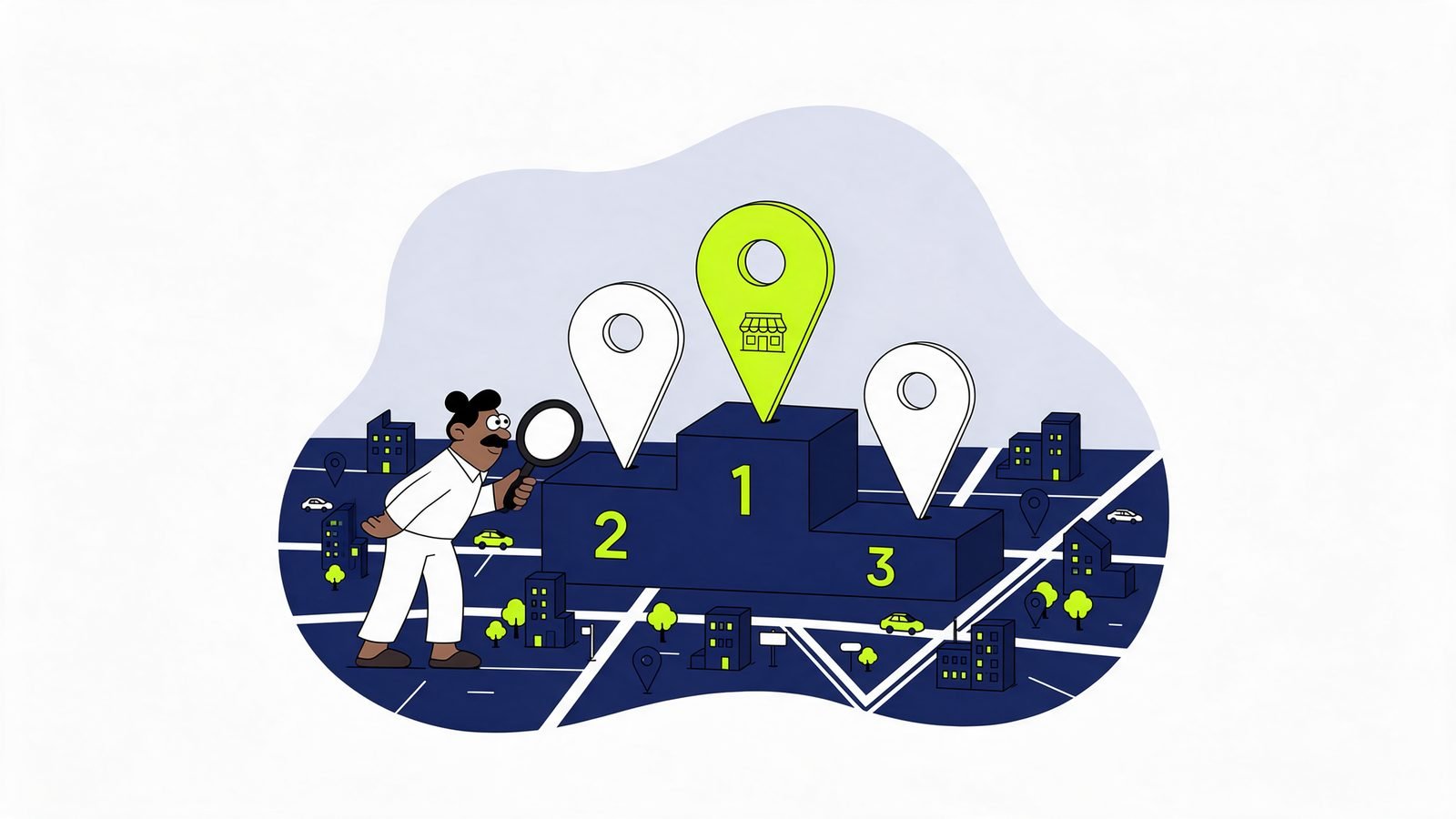
What Google officially says decides local rankings
Google's help page on improving your local ranking names three factors:
- Relevance: "how well a Business Profile matches what someone is searching for". Complete, detailed information helps Google make that match.
- Distance: "how far each business is from the customer who's searching". If the searcher's location is unknown, Google estimates it.
- Prominence: "how well-known a business is", including signals from links, articles, directories, reviews and ratings.
It also says something worth repeating to anyone selling "guaranteed map rankings": "There's no way to request or pay for a better local ranking on Google."
Google does not publish the weight of each signal. To go further, the best evidence we have is a mix of large surveys of practitioners and data studies, which is what the rest of this guide uses.
The top 10 factors for the map pack, according to experts
Whitespark's Local Search Ranking Factors report is one of the longest-running surveys in local SEO. The 2026 edition asked 47 specialists to score 187 factors. These are the ten highest-scoring factors for the local pack and Google Maps:
Summed scores from 47 experts. Highlighted: factors most businesses can improve this month.
Source: Whitespark, Local Search Ranking Factors 2026 (published November 2025).
Notice how many of these you either cannot change (distance) or should not game (your business name, which we come back to below). The factors you can genuinely improve are your categories, hours, address accuracy, map pin and reviews.
What rose fastest since 2023: hours and services
The most useful part of the 2026 report is what changed. Two simple profile fields jumped dozens of places in the experts' ranking.
Services in your profile moved from 110th to 35th. Proper hours moved from 85th to 21st.
Source: Whitespark, Local Search Ranking Factors 2026.
This matches what Google is doing elsewhere. If your profile shows you as closed at the time of search, you are far less likely to appear, and experts now rank "open at the time of search" fifth overall. Accurate regular hours, plus special hours for festivals and holidays, are some of the easiest wins available.
Meanwhile, some older tactics slipped. Directory citations lost weight again, continuing a decade-long decline, and several website link factors dropped. They still matter, just less than the basics on your profile.
The business name question: keywords help, but they are a trap
Keywords in the business name rank third in the expert survey, and a September 2026 Whitespark study of more than 1.4 million listings backs it up. Listings with an exact-match keyword in their name reached the top three far more often in several industries.
Correlation, not proof of cause. Retail category only; the effect was weaker in some industries such as real estate.
Source: Whitespark, How keywords in business names impact Google local pack rank and AI (3 September 2026).
Here's the catch. Google's rules say your profile name must "reflect your business's real-world name", as seen on your signage, stationery and registration. Adding words like "Best Dentist Bangalore" to a name that is really "Smile Care" breaks the rules. Competitors can report it, Google can remove the extra words, and Google's guidelines say unnecessary information in a business name can lead to suspension.
The honest version is to choose or register a descriptive name in the real world, for example as a trade name with matching signage. If your real name already includes what you do, you have an advantage. If it does not, do not fake it.
Reviews: quantity, quality and freshness
Two of the top ten factors are about reviews: a high star rating and the number of Google reviews with text. Review signals as a group also gained weight in the 2026 survey.
Customers weigh reviews the same way. In BrightLocal's 2026 survey, 74% of consumers only consider reviews from the last three months, and 47% will not use a business with fewer than 20 reviews.
The practical plan is simple and fully within Google's rules: ask every satisfied customer, make it easy with a direct link or QR code, and reply to every review within a day or two. Our Google reviews guide covers the rules in detail, including what gets reviews removed.
Your 10-step plan, in priority order
- Pick the most specific primary category that describes your core business ("Dental clinic" or "Orthodontist", not just "Doctor"). Google's guidelines ask for as few categories as possible, chosen for your core business.
- Add relevant secondary categories, but only for services you actually provide.
- Check your address and drag the map pin to your exact entrance. If you are a service-area business with no storefront, hide the address and set service areas instead.
- Set accurate regular hours, and add special hours for every holiday and festival in advance.
- Select every predefined service that applies, then add custom services in plain words customers use.
- Write your description in two or three sentences: what you do, for whom, where. No keyword stuffing.
- Upload real photos: exterior, interior, team and work. Keep adding new ones each month.
- Ask for reviews consistently and reply to all of them.
- Link to the right page on your website, with the same name, address and phone number.
- Post updates and offers for real news, such as new services, festive offers and events.
Our Google Business Profile checklist walks through each field in detail.
What you cannot control, and what to do about it
Proximity is the second-strongest factor, and you cannot move your shop. If you are 5 km from a customer who searches "jeweller near me", a well-optimised competitor 500 metres away will usually win that search.
That is not a reason to give up. It is a reason to:
- Win the searches where distance matters less: specific services, brand names you stock, or problems you solve ("hallmarked gold exchange", "invisible braces for adults").
- Build your website pages for those specific searches, which can rank across a wider area. See our India local website SEO guide.
- Be the best result nearby: complete, recent and well-reviewed beats a half-empty profile next door.
Ranking factor questions
Does posting on Google Business Profile improve rankings?
Posts are not among the top-ranked factors in expert surveys, but they keep your profile active and give customers current information such as offers and events. Treat posts as a conversion tool that may also help engagement, rather than a direct ranking lever.
Do I need to reply to reviews to rank higher?
Google lists replying to reviews among its own tips for improving local ranking. The clearer benefit is with customers: in BrightLocal's 2026 survey, 89% expected business owners to respond to reviews.
How many categories should I choose?
Google asks you to use as few categories as possible to describe your core business. Choose the most specific primary category, then add secondary categories only for services you genuinely provide.
Will adding keywords to my business name get me suspended?
Adding words that are not part of your real-world business name breaks Google's guidelines. Google may remove the extra words if reported, and its guidelines say unnecessary information in a business name can lead to suspension.
How can I see where my profile is weak?
Compare your profile with the top three businesses that appear for your main search. Our free GMB ONE audit does this automatically, scoring your profile across eight areas and comparing it with three nearby businesses.
About the author
Praveen Kumar, Founder, Vectura Digital
Praveen Kumar is the founder of Vectura Digital, which builds SEARCH ONE, a website audit for SEO, AEO and GEO, and GMB ONE, a Google Business Profile audit. He works with local businesses in India on how search engines and AI assistants read and recommend them.
Sources
- Google Business Profile Help, Tips to improve your local ranking on Google
- Google Business Profile Help, Guidelines for representing your business on Google
- Whitespark, Local Search Ranking Factors 2026
- Whitespark, How keywords in business names currently impact Google local pack rank and AI search (3 September 2026)
- BrightLocal, Local Consumer Review Survey 2026